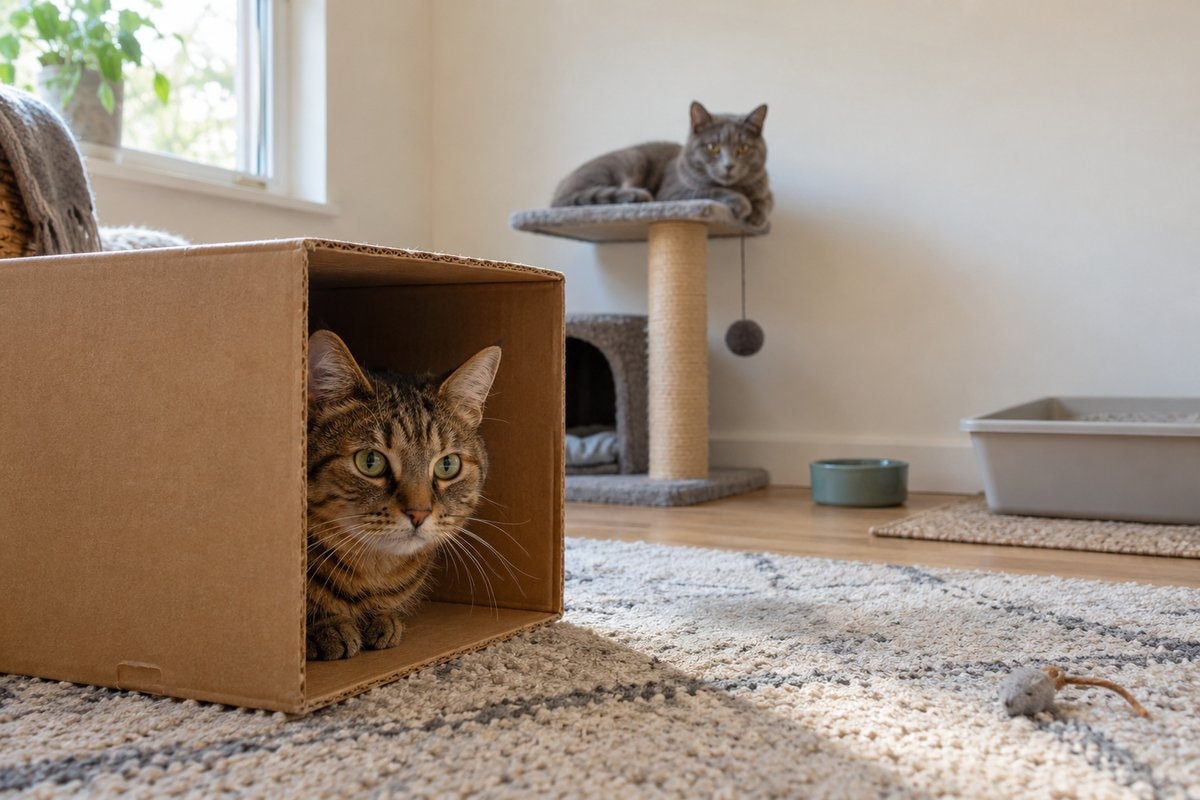
Adopting a rescue cat means choosing a companion whose needs fit the household and making room for a gradual introduction. Consider the quiet spaces, daily care and resident animals as carefully as the cat's appearance. Contact a shelter or rescue directly to discuss adoption. Ask who has observed the cat, in what setting and what is known about living with people or other pets.
Choose by daily needs as well as age
If a kitten is being considered, discuss supervision, play, feeding and veterinary follow-up with the rescue. Think about who will provide care during the working day and how the home will be made safe for exploration. With an adult cat, ask about the routines already observed and what the organisation expects may need time or adjustment after the move.
A label such as friendly or shy needs context. Ask whether the cat approaches familiar caregivers, accepts handling or prefers company nearby without being held. Find out how long the organisation has been observing the cat and which parts of its earlier life are uncertain. Avoid turning missing information into either an alarming story or a promise of easy settling.
Read choosing a pet for your household before deciding. A busy shared space, a quiet home and a home with resident pets present different practical questions. Describe your circumstances accurately so the organisation can discuss the match rather than work from an ideal picture of your routine.
Ask about pairs and existing companions
If the rescue recommends that cats stay together, ask what observations support that recommendation. Discuss how they share rest, play and resources, and what space the household should provide. Do not assume that any cats living in the same room are a suitable pair, or that adding another cat automatically supplies the companionship a shy cat needs.
When resident cats or dogs are present, ask whether the prospective cat has relevant experience and how it was assessed. Even an encouraging answer calls for a careful home introduction. Plan separate resting and feeding areas before arrival, with a way to supervise progress. The page on introducing a new pet helps organise that process.
Give a shy cat a safe starting place
Prepare a quieter room with a resting area, hiding place, food, water and an accessible litter box. Check windows and doors, remove hazards and make sure hiding spaces remain safe to monitor. A simple box can offer privacy without making necessary observation impossible. Keep visitors and resident animals outside while the new cat begins to learn the space.
Allow the cat to choose whether to approach. Spend calm time nearby without repeatedly reaching into the hiding place, and ask the rescue how it has encouraged comfortable contact. Introduce more space only when it can be managed. Avoid setting a deadline by which the cat must tolerate holding or join every household activity.
Wikipedia's cat-behaviour reference describes variation in communication and sociability among cats. Observe posture and responses in context, rather than deciding personality from an isolated action. If handling is difficult or the cat seems persistently distressed, get advice from the rescue and a qualified behaviour professional. A veterinarian should assess concerns that might involve health.
Understand FIV and FeLV as veterinary information
Wikipedia's reference on feline immunodeficiency virus describes FIV as a virus affecting cats, most often transmitted through deep bites, and notes that an infected cat can remain without symptoms throughout its life. That does not predict an individual cat's future. Ask a veterinarian to explain the test records, their interpretation and the care questions relevant to your household.
Wikipedia's reference on feline leukemia virus describes FeLV as a different virus that can pass between cats through saliva and close contact, and can weaken the immune system. Discuss the implications with a veterinarian before introductions to resident cats. The record should be understood as part of a veterinary assessment, not translated into a decision from initials alone.
Request the actual records rather than relying on a short description of test status. Ask whether additional assessment or follow-up is expected and who has explained the results. Use the first vet-visit guide to prepare questions about testing, routine care and any observations after arrival. No general page can supply the cat's diagnosis or care plan.
Make the litter area easy to use
The ASPCA's litter-box guidance describes possible problems involving cleanliness, access, location, litter preferences, household conflict and medical issues. Ask the rescue about the setup the cat already uses. Start with an accessible box in a quiet location and keep food away from it. Arrange resources so another animal cannot control the only route to the toilet area.
Keep the box clean and notice changes in use. Do not punish a cat for toileting outside it or force the cat into the box. The ASPCA advises veterinary assessment when addressing elimination problems, because a household adjustment alone may not explain them. Tell the veterinarian what was observed and ask the rescue for the earlier routine.
Provide an interesting indoor life
The ASPCA's general cat-care reference recommends indoor housing and a sturdy scratching surface. Plan places for rest, observation and scratching as ordinary parts of the room. Wikipedia's cat-behaviour reference also describes play and enrichment suited to predatory behaviour. Offer supervised play with suitable toys and allow the cat to leave the activity when it chooses.
Ask which scratching surfaces and play styles the cat has used. Keep hands out of rough games and store loose play items safely afterward. An indoor home still needs daily attention, cleaning and observation. Build those tasks into the household routine rather than expecting the cat to manage entirely on its own.
Good preparation leaves room for the cat to become familiar with its home without pressure. The objective is a manageable setting, informed veterinary care and a relationship that respects the cat's pace. If the plan is proving difficult, ask the shelter or rescue directly for guidance before frustration becomes the dominant part of care.