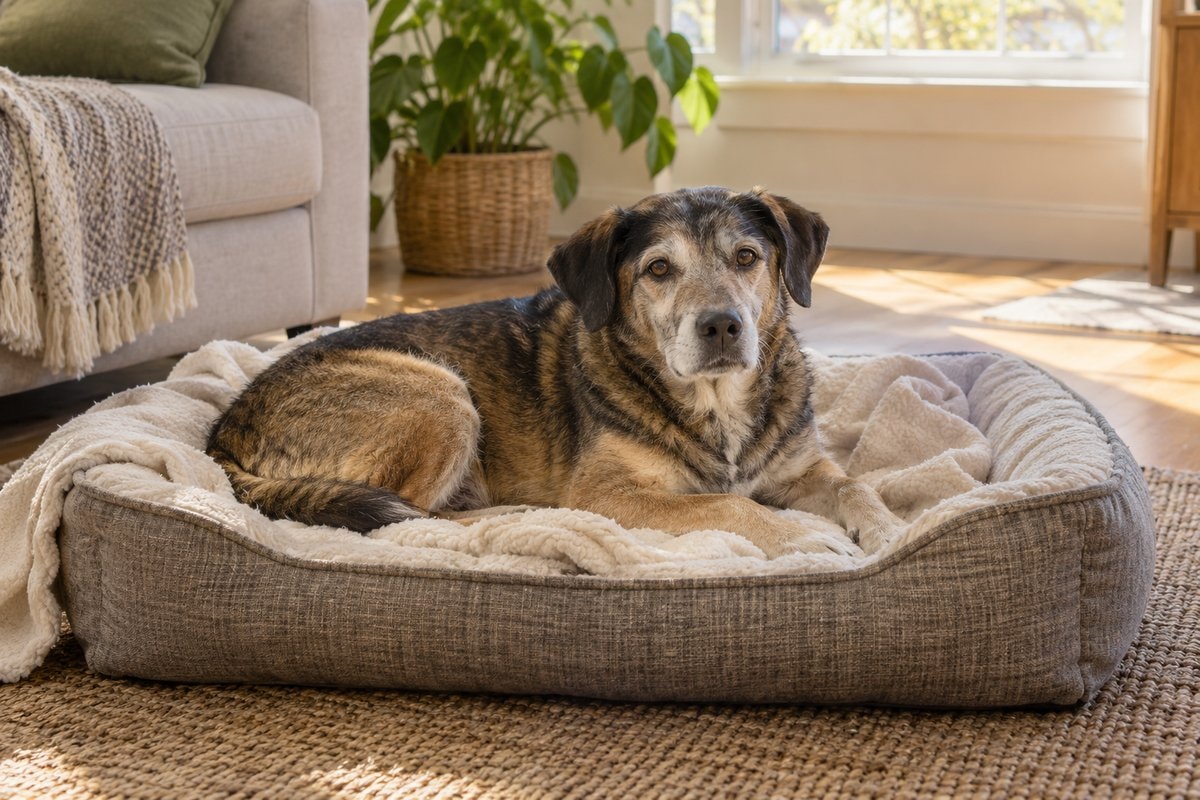
Considering a senior rescue dog or a dog with special needs means looking closely at ordinary tasks. Can the dog reach the garden, rest comfortably and join the household at its own pace? Who will help with journeys and ongoing care? Affection matters, but a dependable routine matters alongside it. Contact a shelter or rescue directly to discuss adoption, and ask a veterinarian to explain the health and mobility information before deciding.
Ask what the description means in daily life
Special needs is a broad description, not a complete care plan. A dog may need extra help after an injury, continuing veterinary attention for a chronic condition or adaptations for weak hind legs. Ask the rescue to describe what happens on an ordinary day. A demonstration of the current routine may be more useful than a general assurance that the care is easy.
Wikipedia's reference on aging in dogs describes possible changes in hearing, sight, movement, appetite and energy as dogs grow older. These are possibilities rather than a checklist that applies equally to every older dog. Ask which changes have been observed and documented. Changes should be discussed with a veterinarian rather than assumed to be an unavoidable part of age.
Find out whether the dog has been observed in a home, on different floor surfaces and around household activity. Ask what the rescue knows about rest, toileting, grooming and handling, and where uncertainty remains. The goal is to understand the responsibility clearly, without turning a medical label into the dog's entire character.
Have the veterinary conversation before committing
Request the veterinary records and the explanation supplied with them. Ask which parts of care need a follow-up appointment, which decisions remain open and whether further assessment is expected. Your veterinarian can discuss the records, the practical demands of care and the questions that cannot be answered from a description. The guide to the first vet visit helps organise what to bring.
Ask about likely continuing appointments and how to plan for unexpected changes without seeking a promise about the dog's future. Discuss travel, grooming and daily activity with the veterinarian, particularly when physical assistance may be needed. Make sure the people carrying out care understand the same instructions. This page does not supply a diagnosis or tell you what to give the dog.
Build the budget around continuing care as well as the initial adoption. Include transport, suitable bedding and any practical help that the household cannot provide alone. Ask the organisation to explain any support arrangement in writing, including its limits. Good intentions are easier to sustain when responsibility for each task is clear.
Mobility help must suit the dog
Wikipedia's reference on dog wheelchairs describes rear-support carts for dogs with weak or paralysed hind legs and stresses the importance of appropriate fit. A cart is a support option to discuss with a veterinarian, not a purchase to make from a photograph. Ask how the dog's needs are assessed, how equipment is fitted and how comfort is monitored.
If the dog already uses mobility equipment, ask for a supervised demonstration and the relevant care instructions. Find out whether equipment comes with the dog and who should check it after the move. Do not improvise fitting, lifting or exercise from general reading. The person giving veterinary guidance needs to consider the individual dog's condition and your home.
Ramps, floor coverings and changes to furniture access may also be worth discussing. Look at the route from the resting place to the door, the width of passages and the surfaces outside. Measure your own space before assuming the current setup will transfer neatly. Ask about safe transport and whether extra assistance is needed to get the dog into a vehicle.
Make room for rest and predictable care
Choose a resting place away from a busy doorway, with an uncomplicated route to water and the usual toilet area. Consider whether stairs can be avoided and how other pets will be kept from crowding that space. These are household planning questions; the veterinarian should guide any adaptation intended for a health or mobility need.
Agree on care responsibilities with everyone in the home. Someone needs to notice changes, keep records together and arrange appointments. A backup caregiver should be shown the routine before an unexpected absence makes help urgent. If tasks involve physical support, establish whether that person can perform them safely and knows whom to ask when something changes.
Leave the arrival schedule open enough for observation. Use the first-weeks guide to plan a quieter introduction to household life. Offer companionship without insisting that the dog join every outing or interaction. Discuss any change in appetite, comfort, movement or usual behaviour with a veterinarian instead of simply revising the schedule yourself.
Keep shelter waiting-time claims in perspective
The ASPCA's shelter statistics page reports longer shelter stays, especially for large dogs, and pressure on shelter capacity. That information does not establish a separate waiting-time pattern for senior dogs or dogs with disabilities. Ask the organisation about the circumstances of the dog you are considering rather than using a broad national observation to predict an individual experience.
Extra care can prompt reasonable questions from an adopter. It should also prompt a careful explanation from the organisation. Avoid a decision based solely on urgency or pity; a home able to carry out the routine is the meaningful objective. An honest discussion of limits gives the rescue a chance to assess the match.
Choose a commitment the household can sustain
Before deciding, review choosing a pet for your household. Ask whether your home, time and support suit the dog's current needs and what would happen if those needs changed. Clarify the rescue's follow-up and return arrangements rather than relying on an informal expectation.
A slower pace or an adapted home need not make companionship less rewarding. The practical commitment is to notice the dog, follow professional guidance and keep asking useful questions. A sound match respects both the animal's needs and the household's real capacity to provide care over time.